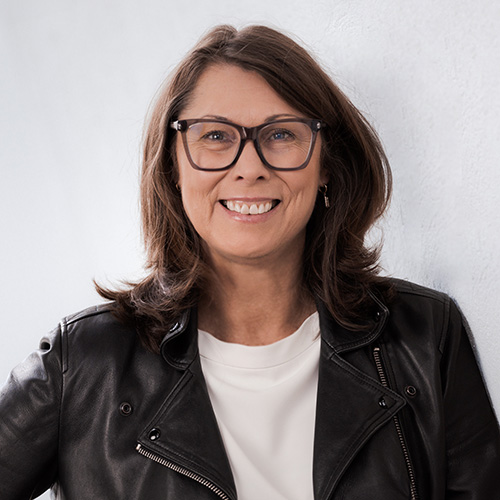
Just as all other companies, we see IoT being discussed everywhere. What has happened that directly affects us is that it is now feasible to put the components in our products, both when it comes to the technology and price aspects. Now it’s time to determine what is possible and when.
Petra Sundström, manager for the Husqvarna Hub
According to Petra, it is not just product development that is affected by the products being able to increasingly communicate with people and each other.
We have to understand that IoT will affect the whole company. Not just marketing and sales, but the entire way of interacting with our customers. We won't be talking about individual connected products either, but rather complete ecosystems.
Petra Sundström, manager for the Husqvarna Hub
From products to fleet management
An example from marketing is offering machine fleet optimisation to larger customers. This is something that can be taken to an entirely new level when users can see how, when and how much the machines are used.
For a customer with several thousand machines of various types, this can make a big difference financially. And for us it's beneficial to obtain information about how the machines are actually used as an aid in subsequently designing even better models. At the same time, we cannot assume that customers will automatically adopt these new developments. We have a job to do here. We have to produce pilot cases, establish training courses, train our dealers and not the least, learn to take a new approach.
Petra Sundström, manager for the Husqvarna Hub
The IoT solutions are not just about basic feedback of operating information. In irrigation systems, Husqvarna has developed the Smart Garden System, where sensors measure moisture levels in the soil. By connecting information about sunlight and weather forecasts, the devices can decide themselves when watering is needed and if the water sprinklers should turn off to let robot lawn mowers do their job without receiving an unwelcome shower.
In this way, information is combined from external data sources at the same time as the devices are communicating with each other to independently make the optimal decisions. Additionally, operating data can be reported to central servers.
It will be a new business model for us and customers will be able to subscribe to the service,” says Petra Sundström. “We’re undergoing a transformation from being a pure product company to becoming a product and service company.
Petra Sundström, manager for the Husqvarna Hub
We first have to understand our competitive edge
At the same time, we have to understand what our core is, that our competitive edge is what we know about the products. We include a service layer to add value, but the foundation is still our products. Based on them, we can go further and develop new services and solutions for our customers, such as ‘Sharing Economy’, where several of our customers share a fleet of tools, which is facilitated by the information we obtain from the IoT solutions.
Petra Sundström, manager for the Husqvarna Hub
Understanding the business core is especially important as we move towards a world in which connected systems are connected with each other.
Customers will demand compatibility between the various systems. That we have not yet attained that is the reason why ‘Smart Living’ has not been realised. But it's only a matter of time because customers want a home system that controls a number of different systems and products. This is why standardisation is so important to us.
Petra Sundström, manager for the Husqvarna Hub
Must be compatible with several standards
While Husqvarna is closely following developments, waiting for a standard to be in place is not an option.
It's likely that different standards that we must comply with will evolve within different areas. Customers may have WLAN. Our products must then be able to ‘speak’ WLAN. Or when a smartphone is the hub, our products must be Bluetooth compatible. We have to be able to take a modular approach to deal with this. We cannot be compatible with everything, but we must be prepared to at least be able to handle a group of different protocols.
Petra Sundström, manager for the Husqvarna Hub
This work naturally entails costs, and questions sometimes come up internally about whether the company will actually profit from the technical infrastructure. Is this backed by solid business logic?
We can look at it from another way. Those who think we can build tomorrow's business logic on today's infrastructure will be left behind.
Petra Sundström, manager for the Husqvarna Hub